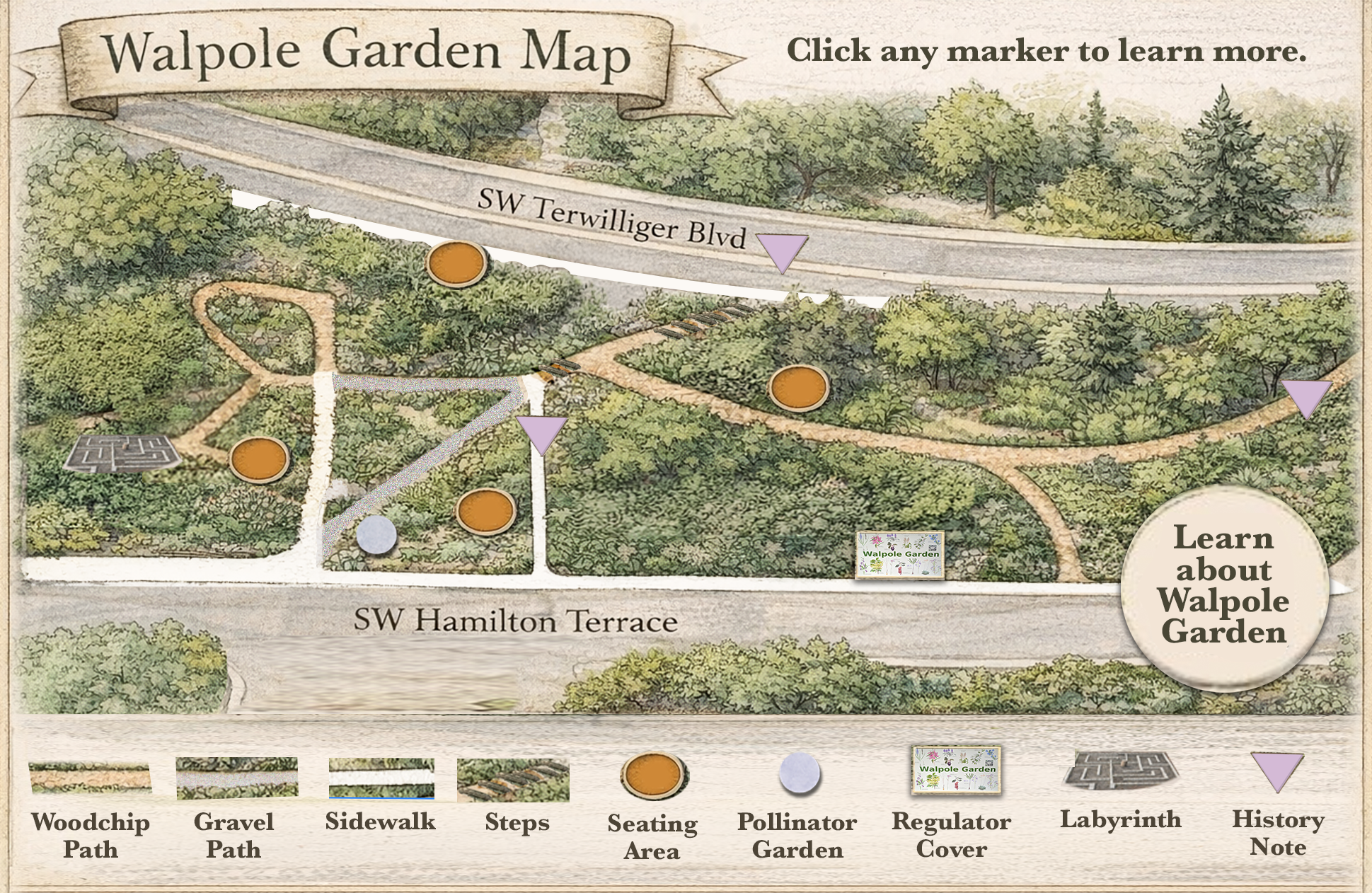
Tap any marker to learn more · Historic Terwilliger Parkway · Portland, Oregon
A rectilinear labyrinth completed in 2024 by neighborhood volunteers, bordered by granite Belgian cobblestones. Offers spectacular views of the Willamette Valley and Mount Hood. Listed on both the Pacific Northwest and international labyrinth directories. Sunset walks with illuminated stone borders are held here throughout the year.
Locust logs arranged as informal benches mark this sunny viewpoint along the main path. A great place to pause and look east across the Willamette Valley toward Mount Hood and the Cascade peaks. Native plantings surround the seating on all sides and are actively being expanded by volunteers.
This upper seating area sits just below SW Terwilliger Boulevard, where the garden meets the road. It offers one of the longest eastward sight lines in the garden, looking out over the treetops toward the Cascades. Native shrubs including Serviceberry and Red Flowering Currant have been planted along the bank above.
Set at the edge of the pollinator meadow, this log bench seating area offers a front-row view of the garden's most active native plantings in spring and summer. Camas, Oregon Grape, Red Flowering Currant, and Western Columbine bloom in succession here from March through August, drawing native bees, butterflies, and hummingbirds.
Tucked beneath a large Douglas Fir, this shaded seating area offers a quieter, cooler resting spot along the east path. Sword Ferns and Salal grow thickly on the slope above; in winter, the red stems of Red-osier Dogwood add color to the understory. A good place to look and listen for birds.
The pollinator garden is one of the most intensively planted areas of the Walpole Garden, featuring a diverse mix of Oregon native wildflowers selected to provide nectar and pollen across as long a season as possible — from the earliest camas blooms in April through Douglas Aster in October. Work in progress.
The concrete sidewalk running through this section of the garden dates to approximately 1908 — predating the construction of SW Terwilliger Boulevard itself. It once served the residential neighborhood that occupied this hillside. Volunteers uncovered and preserved this original infrastructure as part of the garden's development.
SW Terwilliger Boulevard was designed by the Olmsted Brothers — the legendary landscape architecture firm founded by Frederick Law Olmsted — as part of a 1903 parks plan for Portland. The parkway was intended to connect Marquam Hill to Council Crest through a continuous scenic corridor. The Walpole Garden sits directly along this historic designed landscape.
The decorative cover on the Northwest Natural Gas regulator station features high-resolution reproductions of Frederick Andrews Walpole's botanical watercolors — bringing his 19th-century illustrations back to the very landscape that inspired them. Northwest Natural partnered with Friends of Terwilliger to commission this installation, which also includes the QR code linking to this guide.
Just 300 feet north of this location, at the promontory known as Eagle Point, Frederick Andrews Walpole built his Portland home in 1894–95. The house itself no longer stands, but the land was purchased by the City of Portland in 2013 after Friends of Terwilliger alerted the city to its sale. It is now part of Historic Terwilliger Parkway.
Discover the full story of the Walpole Garden — the plants growing here, the history of the land, and the remarkable life of Frederick Andrews Walpole himself. Visit the information page for plant cards, a biographical timeline, and links to Walpole's botanical illustrations at the Hunt Institute.
Visit the Walpole Garden Page →