Historic Terwilliger Parkway · Portland, Oregon
A living botanical garden honoring a forgotten master — and the native plants he drew into permanence
Welcome
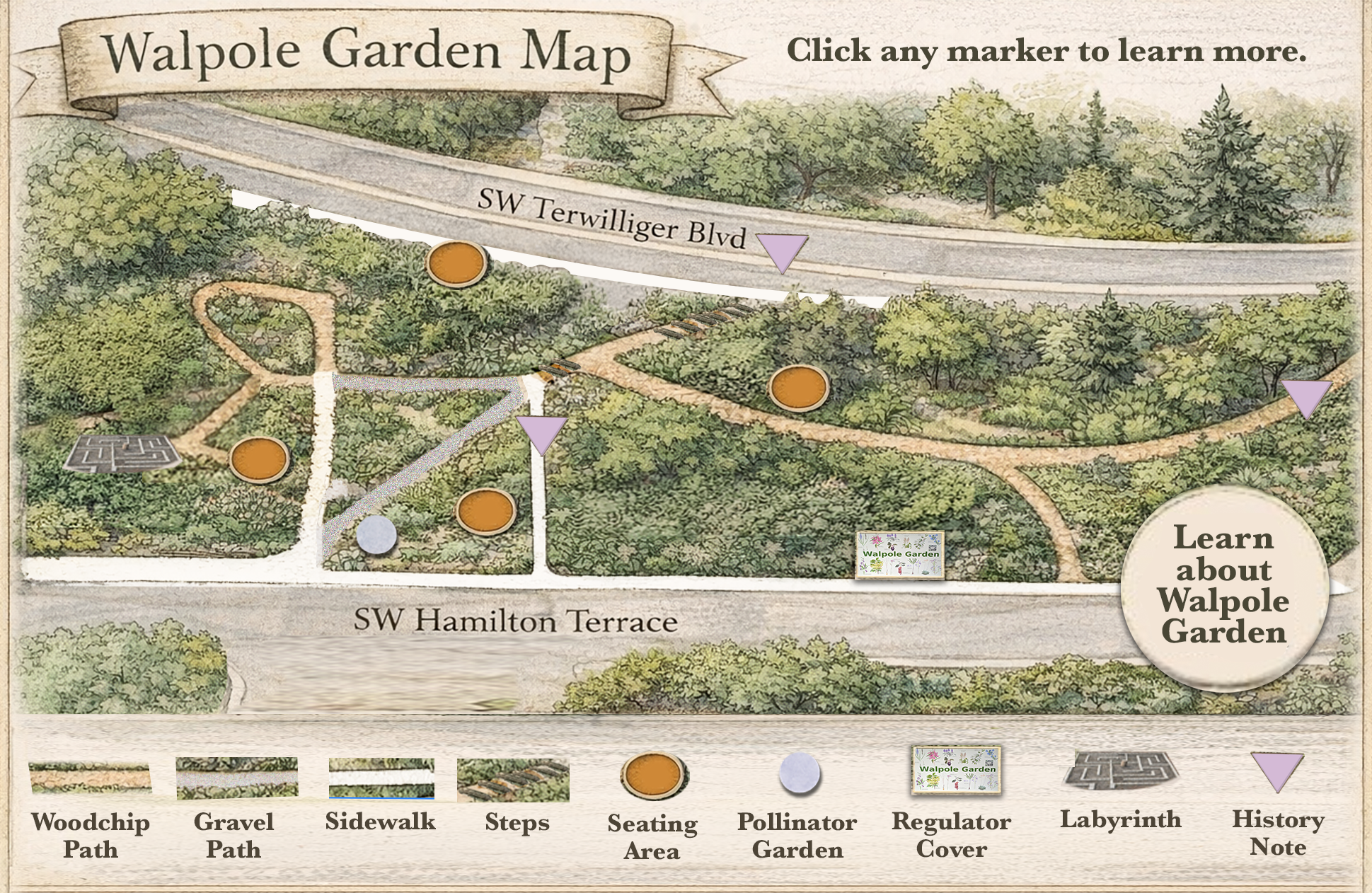
Nestled along the west hillside of Portland, the Frederick Andrews Walpole Garden is a one-acre public space between SW Terwilliger Boulevard and SW Hamilton Terrace with unobstructed views of the Willamette Valley, Mount Hood, and the Cascade Range.
In 1894, the important botanical illustrator Frederick Andrews Walpole built his home at Eagle Point — just 300 feet north of the Garden. We are working to plant as many Oregon and west coast species as possible here; many were first documented by Walpole for the Botanical Gardens and Smithsonian in Washington D.C. between 1896 and his early death in 1904.
The garden is a collaboration between Friends of Terwilliger and Portland Parks & Recreation, built steadily over several years by community volunteers. It includes a native pollinator garden, a rectilinear labyrinth with Cascade views, woodland paths, seating areas, a shade garden, and an ever-expanding collection of Oregon native plants.
Whether you are visiting for the views, the plants, or the history, we invite you to slow down, look closely, and discover what grows here.
Garden Guide & Map
Tap any marker on the map to learn about that feature — the nearby plantings, the views from that location, and what makes it special.
→ Open the Interactive MapThe Garden
The Walpole Garden occupies a long, narrow strip of land — roughly one acre — running between SW Terwilliger Boulevard above and SW Hamilton Terrace below. The site encompasses several distinct microclimates, from an open sunny plateau with sweeping eastward views to a cooler, shaded woodland corridor to the north.
The labyrinth, completed with neighborhood volunteers in 2024, is listed on both Pacific Northwest and international labyrinth directories. Old sidewalks from 1908 — laid before Terwilliger Boulevard existed — have been uncovered and incorporated into the path network. Along the steep eastern slope, remnant grape vines survive, possibly planted by Italian immigrant families who once lived here.
History in Brief
The story of this garden spans more than 130 years — a pioneering west coast botanical illustrator, a federal botany program, a Portland neighborhood, and a community of volunteers who refused to let either the land or the legacy be forgotten.
Frederick Andrews Walpole is born in Port Douglas, New York. His family moves to Chicago, where he studies drawing under a local artist.
At 21, Walpole travels west by rail and on foot from California to southern Oregon, walking 177 miles to claim a homestead near present-day Trail, in the Crater Lake region.
Walpole moves to Portland and works as an illustrator at the Lewis & Dryden Printing Company, sketching the Pacific Northwest landscape and its plants.
Walpole builds his home at Eagle Point — 300 feet north of what is now the Walpole Garden — with commanding views east toward the Cascades.
USDA botanist Frederick V. Coville discovers Walpole's plant drawings while conducting fieldwork in Oregon and persuades him to apply for the position of botanical artist for the USDA Division of Botany. Walpole is appointed in September.
Working from living plants in their natural environments, Walpole spends summers in the field across the Pacific Northwest and Alaska, and winters completing illustrations at the National Herbarium in Washington, D.C. He produces over 800 works — widely regarded as the finest plant artist in the United States.
Frederick Andrews Walpole dies of typhoid fever on May 11, while working in Santa Barbara, California. He is 43 years old.
The Hunt Institute for Botanical Documentation at Carnegie Mellon University publishes Paintings and Drawings by Frederick A. Walpole, the first major retrospective of his work.
Friends of Terwilliger helps alert the City of Portland to the sale of Eagle Point. The city purchases the one-acre parcel and adds it to Historic Terwilliger Parkway.
Friends of Terwilliger and Portland Parks & Recreation begin clearing invasive plants and establishing the Walpole Garden. Volunteers plant native species, build paths, install seating areas, and create the labyrinth.
The rectilinear labyrinth is completed. Northwest Natural Gas installs Walpole Garden signage featuring high-resolution reproductions of Walpole's botanical watercolors.
About
Frederick Andrews Walpole was, by any measure, a remarkable and somewhat mysterious figure. Self-taught, solitary, and relentlessly curious, he came to the Pacific Northwest not as a scientist but as a homesteader seeking land — and ended up producing some of the most precise and beautiful botanical illustrations in American history.
His working method was unusual. Rather than drawing from dried specimens, as most illustrators of the era did, Walpole insisted on drawing from living plants in their natural environments. He spent summers in the field — traveling to remote corners of Oregon, Washington, and Alaska — making detailed sketches outdoors, then returning to the National Herbarium each winter to refine and complete his work.
His technique was equally distinctive. Using a fine sable brush from which all but a few bristles had been removed, and holding it nearly parallel to the paper, he produced ink lines of extraordinary delicacy — lines so fine they resembled engraving but were drawn entirely by hand.
Walpole's 800-plus works are held at the Hunt Institute for Botanical Documentation at Carnegie Mellon University, on indefinite loan from the Smithsonian. All are in the public domain and available for download.
Frederick Andrews Walpole, c.1896
Courtesy Hunt Institute / Smithsonian
Learn
Each plant here is native to Oregon and representative of the flora Frederick Walpole documented during his years of fieldwork in the Pacific Northwest. Each card shows a photograph and a botanical illustration in Walpole's style.
Flowering Plants
One of the Pacific Northwest's most culturally significant plants. The Kalapuya of the Willamette Valley relied on its edible bulbs as a primary food source — pit-roasted for sweetness, dried into cakes, and traded across the region.
This low-growing perennial blooms in vivid pink to purple from early summer through fall. It thrives along riverbanks, mountain stream edges, and rocky alpine slopes, and is especially valuable to native bees and honey bees.
Tall spires of deep blue-purple, helmet-shaped flowers attract bumblebees, hawk moths, and hummingbirds. The hooded shape allows only long-tongued insects to reach the nectar inside.
A small but striking annual wildflower of seasonally wet habitats, producing bright blue blooms with a distinctive white and yellow center. Found in vernal pools and wet meadows from California to Oregon.
The smallest of the western lupines, growing in compact mats with dense spikes of blue-purple flowers. Its roots fix nitrogen from the air, enriching the soil for neighboring plants.
Large, three-petaled flowers in pale purple with a distinctive green midrib stripe. The name means "butterfly" in Spanish. Indigenous peoples of the Pacific Northwest harvested the edible bulbs in spring.
Shrubs
White flower clusters appear in early spring — one of the season's first blossoms. By midsummer it produces sweet blueberry-like fruits gathered by Indigenous peoples and wildlife alike.
Each spring its clouds of pale to deep blue flowers are one of the most spectacular sights on the Oregon coast ranges. An evergreen shrub beloved by bees, butterflies, and hummingbirds.
Oregon's state flower since 1899. Spiny holly-like leaves turn bronze-purple in winter. Honey-scented yellow flowers in spring give way to dusty blue-black berries. Used medicinally by Indigenous peoples across the Pacific Northwest.
A deciduous thicket-forming shrub. White flower clusters in spring become small dark fruits in late summer — valued for jelly and preserves. Birds consume the berries eagerly.
Groundcovers & Small Plants
Compact, succulent-leaved plants built for survival in rocky, exposed conditions. Thick water-storing leaves allow them to thrive through summer drought.
A hardy perennial of alpine and subalpine zones across the Cascade Range. Kidney-shaped, fleshy leaves are edible — pleasantly sour, rich in vitamin C.